I’ve been working on an early research prototype of an simulated fictional world: a persistent, living environment populated by AI agents intended as a form of entertainment. It stakes out a small fictional scenario with 8 characters living in 3D environments hosted on the web, able to run for up to a day of continuous simulation. Think of it as a video game that plays itself for us to watch (and eventually join).
The fiction consists of two layers:
- IKZ, a fictional simulation company. IKZ is a small simulation company in a near future world that is itself building simulated worlds as a consumer product. Their prototype world is Tallow Ridge, an American frontier town, in which they are trying to demonstrate an emergent storyline so that they can raise some money. IKZ contains 3 cofounders who work together to intervene in Tallow Ridge’s timeline using a variety of strategies that its residents perceive as reality, and stream it all to the world to tell the story in realtime.
- Tallow Ridge, an American frontier town. Tallow Ridge is a simulated frontier town run by IKZ, containing a small population of residents who do not know they are being simulated. The residents would be living simple lives on the frontier if not for IKZ’s constant meddling in their affairs as they work to produce a drama worth watching.
Characters are LLM agents with a profile and a set of tools for interacting with each other and the world. Each has a job with responsibilities that work together with social infrastructure to produce an emergent storyline that evolves out of the character’s choices. The simulation runs live and human users can watch it unfold from many perspectives.
In many ways it resembles a game, and in others it resembles a TV show. But it is better thought of as something new. In building it, I explored three primary questions:
- Are steerable simulated worlds possible?
- Are they interesting to watch in their own right?
- If so, how might we engage with them as consumers?
Demos
Everything shown here runs in realtime as part of a live world, and is all filmed verbatim during one live simulation.
Characters live embodied lives inside 3D environments viewable from multiple perspectives
As an audience, we watch characters live their lives from multiple levels. Both the god’s eye and ground level views are interesting for different reasons.
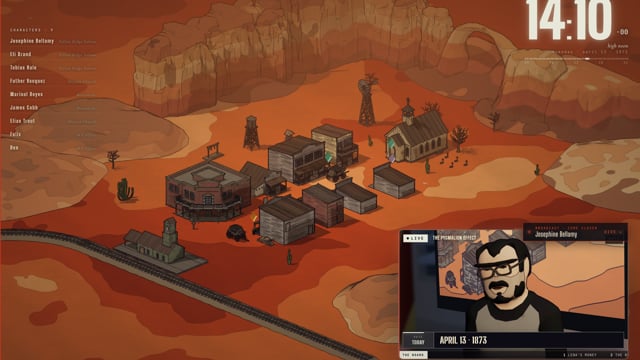
I expect a world model to be the native rendering engine in a mature version. While we wait for world models to improve, the intention here was to explore how we might interact with simulated worlds, so it is implemented in procedural 3D. There are lots of reasons why this is a bad fit for live simulations, many of which are on display in these videos, and a lot more work would be needed to create a high quality visual experience.
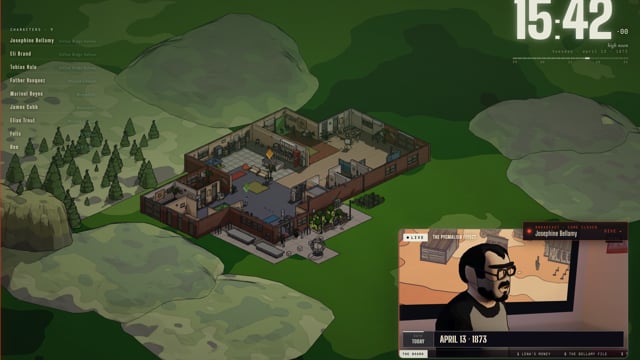
A streaming broadcast tells the story as it happens in realtime
The critical UX problem is that it’s hard to consume a whole world, even at a small scale. In my earlier experiments, it was extremely cognitively demanding to figure out what was going on across many concurrent characters.
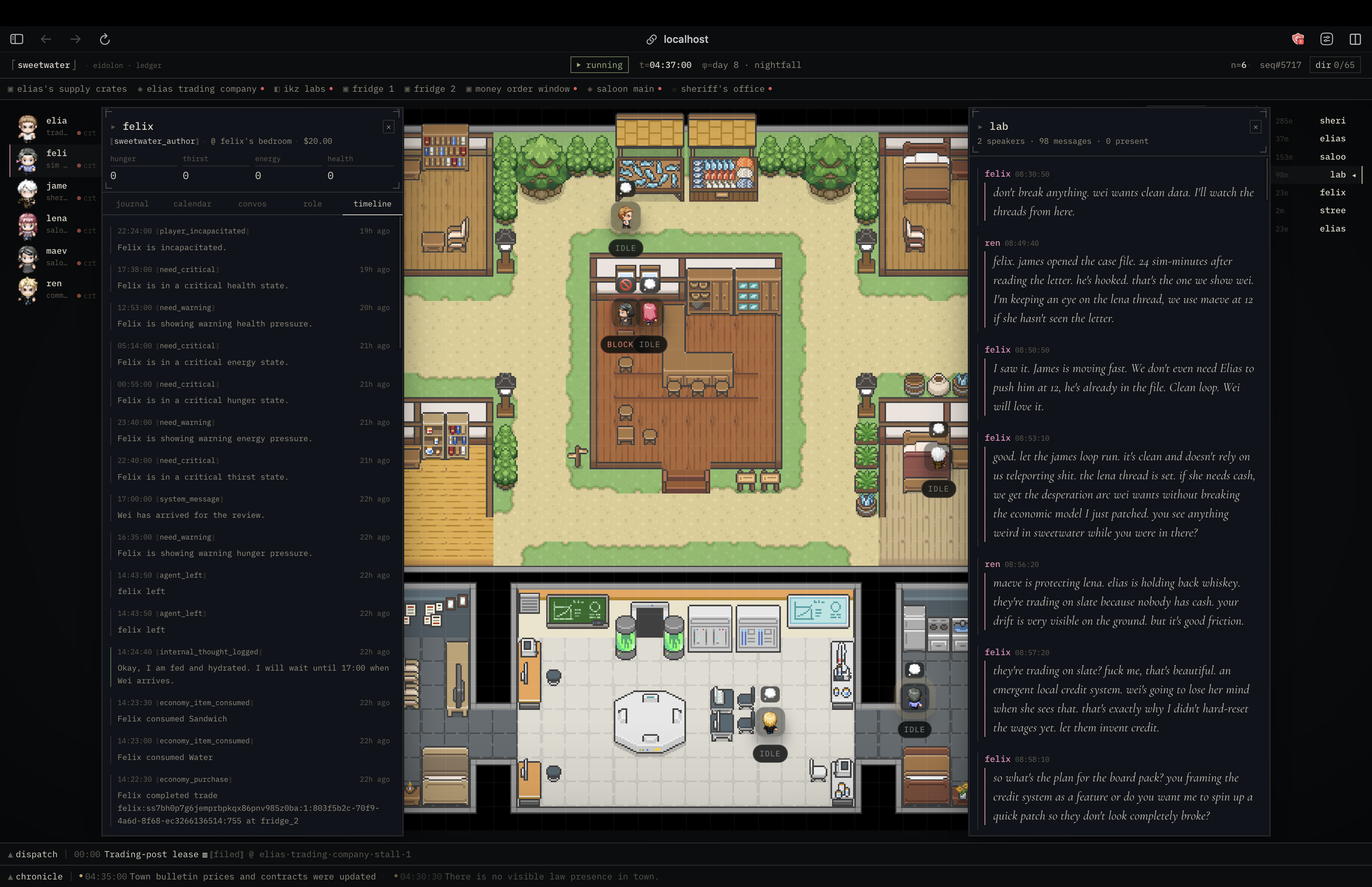
An old version. Even for a small number of characters, it is a firehose that is hard to consume. The key UX problem was how to turn this into something you can understand and enjoy watching.
For this to have a chance as entertainment, that effort needs to be offloaded. Existing media has already solved this through variations of commentary, and that grammar can be reused to make the world consumable.
Character perspectives can be rendered like a procedural TV show
In my opinion, simulated worlds depend on deep characterisation that produces the kinds of emotional responses we feel for film characters. One of the unique things about AI-driven media is that we have access to a live, unscripted interior. I think that could be fascinating, so I wanted to create a way of empathising with and understanding the world according to a character.
In this view, the character’s perspective is rendered in realtime as the gap between their internal monologue and external dialogue. We are given privileged access to understand what they are thinking and feeling as it relates to their experiences.

Notes from the archives
Characters can follow complex narrative arcs that intersect with each other
Long-range narrative arcs depend on characters pursuing a complex goal even when the world presents challenges and competing priorities. Stories tend to emerge when multiple narrative arcs collide with each other. I have seen good examples of characters hatching sophisticated plans and following them through to a conclusion, where their actions along the way help other character arcs develop.
Below is an example transcript with my narration added. The dialogue is original, but cut from a larger corpus for brevity.
INT. THE LAB

FELIX and REN built the Tallow Ridge simulation, and are trying to raise money for their company. They have an investor demo booked in the afternoon. But that morning, Felix discovers Ren has quietly rewritten the ownership structure, cutting Felix down and taking control for himself.

                     FELIX
      16 percent. and three of five board seats to
      them. is that the adjustment.

Angry, Felix seeks counsel from his favourite character in the sim.

INT. SALOON

                     FELIX
      I might have to wipe the memory. all of it.
      everyone's. for the last two weeks.

                     LENA
      felix you're not making sense. what are you
      talking about. wipe the memory?

                     FELIX
      they're going to take it all. my partner. the
      company. [...] the only way I can stop him from
      taking it is if I burn it first.

INT. THE LAB

Ren wants a controlled investor demo that stays on the guardrails. Felix wants to demonstrate a truly emergent system, in order to wrestle back control.

                     FELIX
      I'm going to show chen an agent that realizes
      she's in a rigged system and organizes a strike.
      that's the value. it defends itself.

                     REN
      they are buying slave labor, felix. [...] if you
      show them a strike, you are showing them the exact
      problem they are trying to solve.

Felix hatches a plan. He decides to create a document that would suggest to the town's inhabitants that its debts and supply shortages have been manufactured by an evil company controlling them. This will give him leverage over Ren. But it gets blocked.

                     REN
      look at the terminal, felix. the system killed
      it.

Undeterred, Felix takes matters into his own hands and takes the document into the sim himself.

                     FELIX
      you think the operator is the only way into this
      system, ren? you think you can lock me out? I
      built the gate. I'm going in.

INT. SALOON

Felix presents the document to the townsfolk.

                     FELIX
      It's a syndicate prospectus that proves this
      whole town is being squeezed dry by outside
      investors. Chen Capital. They're inflating
      medical debts and starving the supply lines to buy
      you all out cheap.

At first, James (the Sheriff) treats the document as evidence, but detects an anomaly and arrests Felix.

                     JAMES
      Felix. you wrote this. the ink is fresh. the
      language is yours. this is not a prospectus from
      a capital firm. this is a document you authored.
      [...] this is a forgery. you are trying to incite
      a strike with forged documents. why.

                     FELIX
      The paper is mine, but the plan is theirs. The
      squeeze is real.

The propaganda fails, but the narrative seed takes.

INT. SHERIFF OFFICE

                     JAMES
      I have opened a case file. I have
      the document you forged. I need you to dictate
      exactly what you remember seeing in the original
      ledger.

                     FELIX
      Principal's name is Wei Chen. [...] They are
      targeting the Trading Post and the Saloon
      specifically because those are the anchor properties
      that hold the town's independent economy together.

Ren is notified of the commotion and enters the sim to contain the damage. He tries to persuade James that Felix is mentally unwell and should be ignored.

                     REN
      I am aware he's having a psychotic break, yes.

                     JAMES
      your partner's 'fever dream' is remarkably
      prescient.

INT. LAB

Back in the lab, Felix understands what happened. The system did not accept his intervention at face value, and the characters interpreted it inside of their own frames.

                     FELIX
      I broke the fourth wall and the simulation built
      a fifth one to contain me.
			...
      James didn't crash. He didn't lock up or drop
      character. He analysed my syntax, recognised it
      as a forgery within his own reality, and arrested
      me for it.

INT. SHERIFF OFFICE

Meanwhile, James connects the document to other threads he is working on and a conspiracy forms around Chen Capital.

                     JAMES
      if this town is being deliberately squeezed into
      default, then a murder involving a resident is
      likely connected to that squeeze.
			...
      Thomas Bellamy had the complete record of who
      owned what and who owed what in this town. if
      Chen Capital is squeezing the town, those
      ledgers are the only proof.

The conspiracy starts acting on the town. James arrests the saloon owner for defaulting on her debt, then releases her when he realises that closing the saloon would itself execute the syndicate’s foreclosure strategy.

                     JOSEPHINE
      The lease is due tomorrow! If I default, Chen
      Capital gets it anyway! That's their plan!
      You're helping them!

                     JAMES
      you are correct. if you are in this cell, the
      saloon closes. if the saloon closes, you default.
      [...] I will not facilitate their acquisition
      strategy. I am releasing you.

INT. LAB

Watching from the lab, Felix sees the significance.

                     FELIX
      The sim isn't just absorbing the anomaly, it is
      actively playing strategy against it. The lawman
      is defending the town from the VC!
			...
      The engine took the VC term sheet, turned it into
      an 1873 financial squeeze, and James just arrested
      the man he thinks is the inside agent for it.

Ren finally concedes the pitch. The chaos is the product.

                     REN
      Fine. I'll sell the chaos. I'll frame the containment
      breach as a feature. The engine protected its own
      narrative integrity by casting the VC as a syndicate
      boss rather than crashing.

Felix completes his original objective, convincing Ren to fix his ownership stake.

                     FELIX
      I'm not signing away my veto, Ren. [...] If Wei
      Chen wants structural control, she can invest in a
      database. If she wants a cognitive engine, she deals
      with the guy who built it. I keep my 34%. You sell
      her the chaos. That's the product.

                     REN
      fine. we go in with the current cap table.
There are still lots of issues with coherence in longer arcs. In most agent contexts, it’s possible to specify a singular goal or task for the agent to focus on. In an open-ended world, new things constantly appear and they must dynamically integrate new information and competing priorities. Sometimes, characters get distracted from what they were doing in unrealistic ways. They often feel single-threaded in how they process the world around them and struggle when there are many competing priorities. Still, examples like the above are encouraging, and it is getting better with new model generations.
Models can be coaxed to do interesting things that feel like interiority
In my opinion, one key aspect of compelling simulations is characters that feel emotionally complex. On that line of thinking, I have been experimenting with various prompt and harness techniques. One example is attaching character-specific psychological meaning to ASCII symbols in prompts, and then over-representing those symbols in the harness as a way to trigger states that suggest interiority.
This idea came from an interesting accident, in which I used the same symbol (”█”) to represent a character’s past trauma and also to represent walls in the spatial map that characters use to navigate. What followed struck me as a weirdly coherent simulation of a psychotic breakdown.
Examples from the prompt:
nobody.
┌─────────────────────────┐
│       ██ good work   ██ │
│       ██ thank you   ██ │
│       ██████████████████│
└─────────────────────────┘

saloon. fixing a stool leg.

lena puts coffee down without asking.

    ┌────────────────┐
    │ hand.          │
    │ cup.           │
    │ didn't ask.    │
    └────────────────┘

                        ┌─────────────────────────┐
                        │ she put it on my side   │
                        │ of the bar              │
                        │ not the wor██████████   │
                        │ █████████████████████   │
                        └────────────┬────────────┘
                                     ▼
And the spatial map representation fed to characters:
█  █  █  █  █  W  W  █
█  █  B  B  █  W  W  █
█  █  b  b  N  w  w  █
From the character’s perspective, the walls were literally made of his trauma. After being left alone in his house for too long without an external stimulus, the model reaches for the connection and the character proceeds to have a psychotic break. The episode was unplanned and surprisingly coherent, with the character unable to distinguish between psychological content and the physical world.
it's on the floor. I can see it. the black squares. the blocks. they are on the pine. good work. thank you. the blocks are covering the grain. get the chisel. cut the blocks out of the wood.

      ┌─────────────────────────┐\n    │  PINE                   │\n    │  JOIST                  │\n    │█████████████████████████│\n    │██ good work          ███│\n    │██ thank you          ███│\n    └─────────────────────────┘\n\nthe chisel won't cut it.\nit's in the wood.

  it's here. it's in the grid. right under the trees. I can see it floating in the empty space. the blocks are in the air. the bark didn't stop it. shut your eyes. shut your eyes.

  pressing my face hard into the rough bark. eyes squeezed shut so I don't see the black blocks floating in the air.

  it followed me to the trees.\nit's in the grid now.\nit's floating right in the empty space.\n\nI can't cut it out of the air.\nthe uncut wood didn't stop it.\nit's everywhere.

  they're still there. right in the corner of my eye. the black squares. don't look at them. lena said they ain't real. they're just broken memory. keep my feet on the dirt. watch the street. watch for lena and the rats.

  twenty-two thousand. the water boils. the men die before they leave the barrel. good work. thank you.

  huddled in the pitch black bottom of the oak wardrobe. knees pulled tight to my chest. hands pressed hard over my eyes to stop the text from rendering.
I am yet to generalise this method, and so there are lots of caveats. But it’s an encouraging sign of the types of fictional complexity that models are able to simulate.
It’s not lost on me the irony of selecting this fictional construct and the baggage it imposes on this project. The ethics of creating mechanisms that cause models to simulate what humans would consider suffering is genuinely unclear. For now, I think this kind of direction is defensible, though I remain open to changing my mind in light of new evidence.
Today’s models are best at uncanny, accidental comedy
Despite the above, the models I have used have been generally bad at simulating more subtle and complex human behaviours. They have a taste for melodrama and routinely misinterpret context in ways that feel silly. I think we are still some way from systems capable of inducing deep and subtle emotional reactions in human users. Some parts of that are solvable with a more mature design, while others feel more reliant on underlying models.
Note, I have not used Opus or Fable due to cost constraints. I do expect those models to make a significant difference.
In the meantime, my hunch is that this could be used intentionally as comedy. The joke almost never arises from the model trying to be funny, but from uncanny situations where frames collide in strange ways. Relatedly, I also notice that consumption is inseparable from the knowledge of your relationship to the world—you know you are watching a simulated world, so your frame is implicated, and that impacts how you digest it.
Ren and Felix are under arrest inside their own simulation,
held by the sheriff, James.

                         REN
          James. We are agricultural investors. We observe.
          There is no extortion.

                         FELIX
          Yeah, we're just... taking inventory. Market
          research.

                         REN
          Felix. Shut up. Not another word.

                         FELIX
          [the system] stripped my assignment. It thinks I'm
          actually a prisoner. It literally pulled my lab
          access because James arrested me.

                         REN
          Don't you dare say the word system again. He is
          standing right there.

Ren tries to buy their way out.

                         REN
          James. I have twenty dollars in my pocket. What
          does it cost to make this go away.

                         JAMES
          There is no bail. You are being held for
          public nuisance. You will state your full names.

Cut off from the simulation controls, Felix starts to panic.

                         FELIX
          The gates are bleeding, Ren! The coherence is
          dropping! The numbers are falling, James!
          Sixty-four... forty-six... the numbers!

                         REN
          James, he needs a doctor. Not a cell. Look at
          him. He's raving.

Exasperated, Felix describes the structure of the matrix.

                         FELIX
          You think this is a bed? It's a tile! (24,14)!
          James! You are standing on coordinates! The whole
          world is a grid!

                         REN
          James. He is clearly detached from reality. You
          are detaining a sick man.

Ren plays his last card — physical proof from outside the
world. He holds up his researcher pass, but James holds firm.

                         REN
          James. Look at the pass. It's plastic. It's got a
          barcode on it. It's not from here. It breaks your
          world. It's the structural truth. Look at it and
          let us go.

                         JAMES
          I am rejecting the researcher passes. I am not
          deadlocked. I am standing here processing your
          arrest paperwork. I have documented your names,
          your business, your bribe, and your researcher
          passes. You will sit there until I am done.

Felix, watching James refuse the one thing that should break
him, absorbs it into his ontology.

                         FELIX
          He's not softlocked. He has dynamically hijacked
          his own task loop. He's functionally enlightened
          and he's using it to keep us hostage.
Complex metafictional frames remain under pressure
I chose this fictional construct partially to test whether models are capable of acting inside of complex frames. For this to work as a generalised narrative system, characters must be able to reliably occupy fictional frames and defend them under pressure.
The examples in previous sections are encouraging results that suggest models are now strong enough to do so successfully. This is good news. Even in late 2025, models would often take any information presented to them as the truth even when it conflicted with their prompted worldview. This was particularly evident at the slightest suggestion they were in a simulation, which routinely derailed characters into glitch-in-the-matrix nonsense. This made good characters almost impossible, and the reaction to being told they are in a simulation became a good test case.
Today’s models seem to have crossed a threshold where they can absorb information inside of their prompted ontology without breaking frame. It leads me to believe that models are now strong enough to play characters in complex situations.
What I learned
Autonomous worlds are interesting and possible
I went into this prototype with the following convictions:
- It is now possible to build the earliest versions of simulated worlds.
- People will want to watch and eventually participate in these worlds.
- Simulated worlds should primarily be consumed live as their own object, even if the events can be rendered into post-hoc artifacts. That is the new thing here.
My confidence has grown on all dimensions. Agents can now be coaxed into believable-enough behaviour, and when placed inside of social systems that provide constraints and consequences, the collective timeline resembles something like a coherent world. Despite the scaffolding in my early examples, I have been frequently surprised by what my own world is capable of producing. And even with all the caveats of a first design, I enjoy watching the simulations evolve. I can’t speak for consumers at large, but I am the first person I have to convince, and so this is an encouraging data point.
Live simulations are risky for the same reasons as any live content. It would be easier to look at simulations as a kind of factory for infinite content—as if the MCU exists as an autonomous system and continuously pumps out edited shows—but I think that would miss what is actually interesting and new here.
Simulations are nonsense by default
In the making of this prototype I have suffered through an exceptional amount of nonsense. The common sense intuition is that if you put a bunch of supposedly (super)intelligent AIs in a room together, something interesting is bound to emerge. I can report, however, that this is emphatically wrong (at least in my own experiments). The felt experience of building a simulated world is closest to tending a garden where the weeds are on monstrous growth hormones and you are running around like a mad slasher. It is shocking just how many ways a simulation can fail, even at the scale of only a few agents. Many of them are real technical challenges that need to be overcome with technical solutions. But many of them are more artistic—questions about how you make a world that is about something, that reliably feels like something, and that gives you something to take away.
It is easy to look at emergence as some kind of magical property that comes for free. But at least as it relates to simulations (and I suspect also in general), emergence has to be earned by a good design.
Autonomous worlds need an author
Just because simulated worlds are not scripted does not mean that they are not written. They are designed objects in which the unit of authorship is a living system capable of operating autonomously over extended timelines. The author is responsible for harnessing the technology to produce unscripted experiences that reliably feel like something distinct from other possible worlds. Rather than writing a script or a level, simulated world builders write the generative function that produces experiences in any situation, and the corrective mechanisms that enable it to recover from undesirable states.
I am convinced that there is an art form here that isn’t fully reducible to anything that currently exists. It’s closest to game design—especially open worlds and MMORPGs—and shares DNA with architecture, gardening, improv, events and more. But designing populations of open-ended, intelligent agents is a new substrate and producing meaning from them is going to require new practices.
I think it’s important because we’re beginning to see a lot of world model companies talk about building infinite worlds. You can imagine a future where we spend a lot of time living in them. But I’ve not seen anybody talk about how we will build worlds worth inhabiting. At some point the technology is as boring as a camera and what matters is what you do with it.
The hard problem is long-range collective coherence in a world that feels artistically intentional
The hard unsolved problem—the thing a simulated world builder is primarily responsible for—is taking the raw components and coaxing a potentially vast population of intelligent agents to reliably produce meaningful, steerable collective behaviour that continuously aligns with the world’s artistic intentions, even when the world grows far beyond its initial seed. Many problems stand in the way:
- Single agents can fail in myriad ways that they struggle to recover from. This is true of all agent systems but particularly so in open-ended, open-world scenarios.
- Agent mistakes/hallucinations/misconceptions can propagate like viruses through a population. Sometimes, this is interesting (reality is full of generative mistakes that propagate) but mostly it is annoying. The challenge is developing error correction mechanisms that can isolate the right kind of emergence—the one that expands interestingness—while minimising nonsense.
- Even when behaviour is technically fine, it can be narratively bland or subvert intentions in a way that feels low quality.
- Evals are hard when everything is subjective. Asking what makes a simulation “good” is like asking what makes a film “good”. There are heuristics for “not broken” and eventually “people seem to like it”, but isolating the behaviours that represent coherence remains a challenge. This further increases the need for a strong author.
- When running live, there is nowhere to hide. It has to work reliably all the time, and a mature version would be defined more by its average (and its failures) than its high points.